



Inspirations
Transparent Trade: How Blockchain Is Changing Ethical Global Sourcing


Introduction: Why Trust Is Now the Most Valuable Currency in Global Trade
Global trade has always depended on trust. For decades, that trust was built through relationships, reputation, and documentation—contracts, audits, certificates, and assurances passed from one intermediary to another. But as supply chains expanded across continents and complexity increased, trust quietly eroded.
Today’s sourcing environment is fundamentally different.
Products are no longer judged solely on price, quality, or delivery timelines. They are evaluated on where they come from, how they are made, who is involved, and what impact they leave behind. Regulators demand proof. Investors demand transparency. Consumers demand accountability. Partners demand alignment.
The problem is not a lack of ethical intent.
The problem is a lack of verifiable proof.
Ethical sourcing claims, sustainability certifications, and compliance statements have become so widespread that they are now met with skepticism. In many cases, brands believe their supply chains are ethical—but cannot demonstrate it with precision, speed, or confidence.
This is where transparent trade becomes a strategic necessity rather than a moral aspiration.
And this is where blockchain, when used correctly, changes everything.
Not as hype.
Not as crypto.
Not as a futuristic buzzword.
But as trust infrastructure.
The Trust Deficit in Modern Supply Chains
Why Traditional Transparency Models No Longer Work
For most of the past 30 years, supply chain transparency relied on three mechanisms:
- Paper-based documentation
- Periodic audits
- Third-party certifications
These systems were designed for slower, simpler supply chains. They assume:
- Static supplier relationships
- Limited intermediaries
- Predictable production cycles
- Low regulatory velocity
None of those assumptions hold true today.
Modern global sourcing involves:
- Multi-tier supplier networks
- Subcontracting across regions
- Rapid product iteration
- Dynamic regulatory requirements
- Real-time reputational risk
In this environment, transparency systems that rely on retroactive verification are inherently fragile.
By the time an audit is completed, the situation has already changed.
By the time a certification is reviewed, the risk has already materialized.
By the time a brand responds to a sourcing controversy, the damage is already done.
This creates a trust gap—not because organizations are unethical, but because their systems are outdated.
Ethical Sourcing Has Shifted from Intent to Evidence
Why “We Care” Is No Longer Enough
The global conversation around ethics has matured.
Stakeholders no longer ask:
- Do you care about sustainability?
They ask:
- Can you prove it—continuously, transparently, and independently?
Ethical sourcing is no longer defined by declarations. It is defined by data integrity.
This shift is driven by three forces:
- Regulatory Escalation
Governments are moving from voluntary frameworks to enforceable disclosure laws:
- Supply chain due diligence
- Forced labor reporting
- Carbon accounting
- Material traceability mandates
Compliance now requires traceable evidence, not statements of intent.
- Investor Scrutiny
ESG is no longer a reporting exercise. It is a risk lens.
Institutional investors want:
- Data lineage
- Audit trails
- Proof of governance
Without verifiable sourcing data, ESG claims lose credibility.
- Market Expectations
Consumers and B2B buyers are increasingly sophisticated.
They can distinguish between:
- Ethical storytelling
- Ethical engineering
The brands that thrive are those that move from claims to proof.
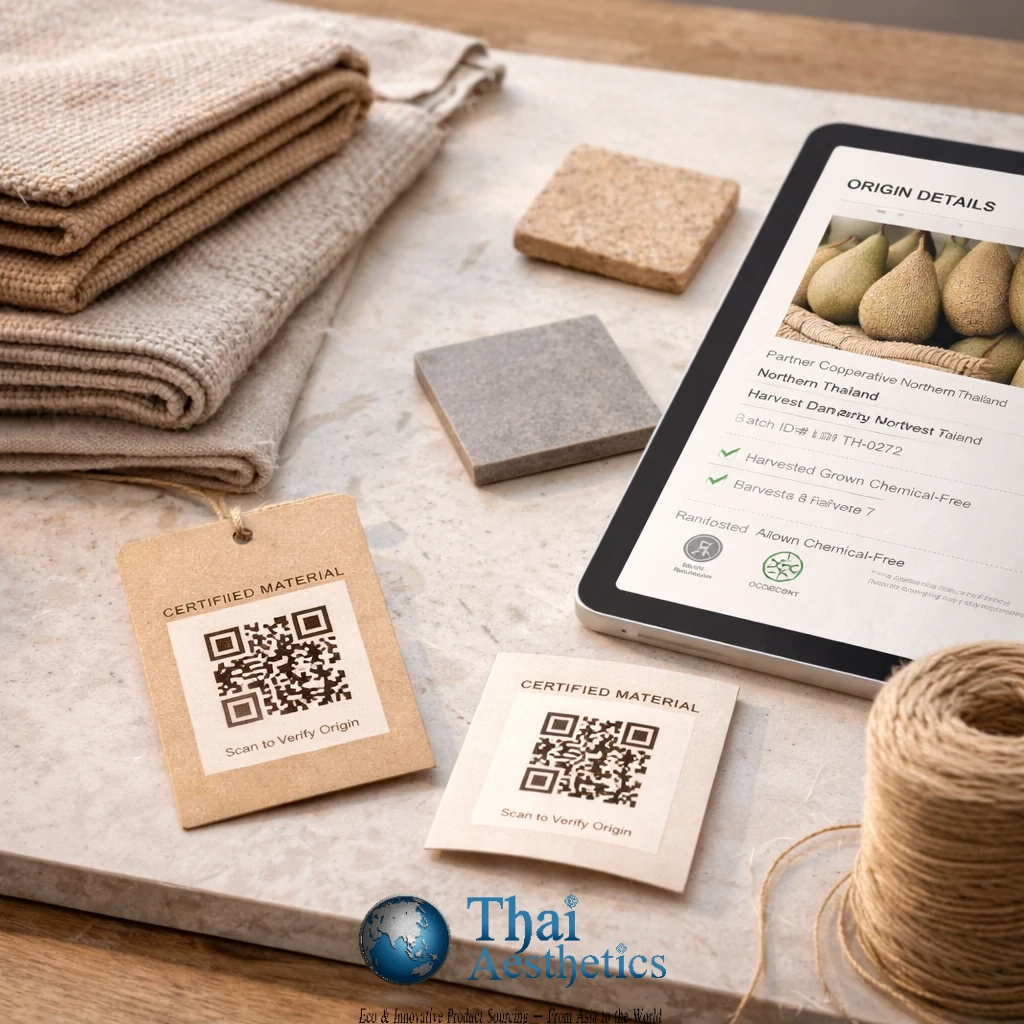
Blockchain’s Real Role in Ethical Global Sourcing
What Blockchain Actually Solves (and What It Does Not)
Blockchain is often misunderstood because it is frequently introduced backwards—starting with the technology rather than the problem.
At its core, blockchain is not about tokens, mining, or decentralization for its own sake.
Blockchain is about immutability, traceability, and shared truth.
In the context of global sourcing, blockchain provides:
- A single source of verified truth
- Tamper-resistant records
- Time-stamped, auditable data
- Shared visibility across stakeholders
What it does not do:
- Replace human judgment
- Guarantee ethical behavior
- Eliminate the need for governance
Blockchain does not create ethics.
It records reality.
That distinction matters.
From Opaque Supply Chains to Verifiable Lineage
How Blockchain Enables End-to-End Traceability
Traditional supply chains operate in silos. Each participant holds partial information, often incompatible with others.
Blockchain enables a different model:
- Every critical event is recorded
- Every record is time-stamped
- Every update is traceable to its source
- Every participant sees the same verified history
This creates material lineage.
For example:
- Raw material origin
- Processing location
- Manufacturing batch
- Quality inspection
- Logistics handoff
- Export documentation
Each step is logged as it happens—not retroactively.
The result is not just transparency, but accountability by design.
Extending Transparent Trade: The Strategic Layers Most Organizations Miss
Beyond First-Tier Visibility: Why Ethical Risk Lives Deeper in the Supply Chain
Most transparency initiatives stop at Tier-1 suppliers. This creates a false sense of security.
In reality, the highest ethical, environmental, and reputational risks often exist several layers upstream:
- Raw material extraction
- Sub-processors
- Informal labor networks
- Regional aggregators
These layers are traditionally invisible to brand owners.
Blockchain’s real value emerges when it is extended beyond contractual relationships into material reality.
By enabling multi-tier traceability, organizations can:
- Identify hidden dependencies
- Detect geographic concentration risks
- Surface labor and environmental exposure earlier
- Reduce “unknown unknowns”
This transforms sourcing from reactive compliance into strategic foresight.
Transparent trade is not about knowing who you buy from.
It is about knowing what your product is made of — and how truthfully that story can be told.
Data Integrity as a Leadership Responsibility
Why Blockchain Elevates Accountability to the Executive Level
When sourcing data is fragmented, accountability diffuses.
Blockchain consolidates responsibility because:
- Data cannot be quietly altered
- Records persist across leadership changes
- Decisions leave permanent traces
This has a subtle but powerful effect on organizational behavior.
When executives know that:
- Supplier changes are recorded
- Exceptions are visible
- Overrides are traceable
Decision-making becomes more disciplined.
Ethical sourcing shifts from:
“What can we justify later?”
to
“What will we stand behind permanently?”
This is why transparent trade is ultimately a governance system, not a technology deployment.

The Economics of Transparency: Why Proof Lowers Cost Over Time
There is a persistent myth that transparency increases operational cost.
In practice, the opposite is true — when transparency is engineered correctly.
Over time, blockchain-enabled sourcing reduces:
- Audit duplication
- Manual reconciliation
- Dispute resolution time
- Supplier onboarding friction
- Compliance overhead
It also improves:
- Forecast accuracy
- Supplier performance benchmarking
- Risk pricing
- Insurance credibility
The return on transparency compounds.
What begins as a compliance investment becomes a cost-efficiency engine.
Transparent trade is not expensive.
Opacity is.
Trust as Infrastructure: Why Partners Prefer Verifiable Ecosystems
In B2B trade, trust is often negotiated individually.
Blockchain enables ecosystem trust.
When distributors, manufacturers, logistics partners, and buyers operate on shared verification systems:
- Onboarding accelerates
- Due diligence compresses
- Disputes decline
- Long-term contracts stabilize
Partners no longer need to “trust the brand.”
They trust the system.
This distinction matters enormously for global expansion.
Organizations that operate transparent trade infrastructures become:
- Preferred sourcing hubs
- Lower-risk partners
- Easier to finance
- Easier to insure
Trust becomes scalable.
Ethical Proof vs. Ethical Performance: Why Both Matter
Blockchain excels at recording what happened.
It does not evaluate whether it was good enough.
That is where leadership judgment remains essential.
Strong transparent trade systems separate:
- Proof (what occurred)
from - Standards (what is acceptable)
This allows organizations to:
- Raise sourcing standards over time
- Compare supplier behavior objectively
- Incentivize improvement
- Remove underperforming partners without ambiguity
Ethics becomes measurable — not ideological.
Regulatory Alignment Without Regulatory Paralysis
How Blockchain Future-Proofs Compliance
Regulations change.
Proof systems should not.
Blockchain allows organizations to:
- Store raw, immutable sourcing data
- Apply new regulatory lenses retroactively
- Respond to audits without reconstructing history
Instead of asking:
“Did we collect the right data?”
Leaders can ask:
“How do we interpret the data we already have?”
This dramatically reduces regulatory anxiety.
Compliance becomes adaptive rather than reactive.
The Human Side of Transparent Trade
Why Technology Must Empower, Not Exclude
One concern often raised is supplier accessibility — especially for SMEs, artisans, and regional producers.
Successful blockchain sourcing models address this by:
- Using simple interfaces
- Integrating with existing workflows
- Minimizing technical burden
- Providing education, not enforcement
Transparent trade fails when it becomes punitive.
It succeeds when it becomes enabling.
Ethical sourcing should lift partners, not marginalize them.
From Marketing Claims to Legal Confidence
Transparent trade changes how organizations communicate externally.
When sourcing claims are backed by immutable records:
- Marketing language becomes more precise
- Legal risk decreases
- Greenwashing exposure drops
- Brand narratives gain credibility
This allows organizations to:
- Speak less loudly
- Speak more confidently
The strongest brands will not make the boldest claims.
They will make the most defensible ones.
Why Blockchain Adoption Is a Strategic Signal to the Market
Markets read signals.
When an organization invests in verifiable sourcing infrastructure, it signals:
- Long-term thinking
- Governance maturity
- Institutional seriousness
- Risk awareness
This matters to:
- Investors
- Strategic partners
- Governments
- Large enterprise buyers
Transparent trade is not just operational hygiene.
It is strategic signaling.
The Transition Curve: How Leaders Should Phase Adoption
Transparent trade is not implemented overnight.
Best-practice adoption follows stages:
Stage 1: Visibility
- Capture key sourcing events
- Establish data standards
Stage 2: Verification
- Lock records
- Enable shared access
Stage 3: Integration
- Connect logistics, QA, compliance
Stage 4: Intelligence
- Analyze patterns
- Predict risk
- Optimize sourcing decisions
Organizations that rush to Stage 4 without foundations fail.
Transparent trade rewards patience and precision.

Why Doing Nothing Is the Highest Risk Strategy
The biggest risk is not adopting blockchain incorrectly.
It is not adopting transparency at all.
In a world of:
- Rapid reputational contagion
- Regulatory escalation
- Supply chain disruption
Opacity is no longer neutral.
It is a liability.
Why Blockchain Works Best as Invisible Infrastructure
Trust Systems Should Be Felt, Not Seen
One of the biggest mistakes organizations make is overemphasizing blockchain as a visible feature.
In reality, the most effective blockchain systems are almost invisible.
Users do not need to:
- Understand the ledger
- Interact with complex interfaces
- Learn new workflows
They simply experience:
- Faster verification
- Clear provenance
- Reliable documentation
- Reduced friction
Blockchain works best when it supports human decision-making, not replaces it.
It is infrastructure—like electricity or internet protocols.
Critical, but not performative.
Ethical Sourcing Becomes Operational, Not Aspirational
From Policy Statements to Embedded Systems
Most organizations articulate ethical sourcing through policies.
Leading organizations embed it into operations.
Blockchain enables this shift by:
- Making compliance continuous
- Reducing reliance on manual reporting
- Enabling real-time exception detection
- Supporting proactive risk management
Ethics move from:
- Annual reports
to - Daily operations
This is a fundamental transformation.
Boardroom Implications: Why CXOs Must Pay Attention
Blockchain as a Risk Management Instrument
For leadership teams, the value of blockchain is not technological—it is strategic.
It helps answer board-level questions:
- Where are our sourcing risks?
- Can we prove compliance instantly?
- How exposed are we to supplier misconduct?
- How resilient is our supply chain under scrutiny?
In a crisis, speed of proof matters more than intent.
Blockchain shortens response time from weeks to minutes.
The Competitive Advantage of Transparent Trade
Why Transparency Outperforms Cost Arbitrage
Historically, sourcing decisions prioritized cost efficiency.
Today, trust efficiency is equally important.
Transparent trade enables:
- Faster partner onboarding
- Reduced due diligence friction
- Stronger distributor confidence
- Higher buyer trust
- Premium positioning
In B2B environments, transparency is not a cost—it is leverage.
Ethical Sourcing as a Partnership Language
Shared Trust Enables Better Collaboration
When sourcing data is shared transparently:
- Partners align faster
- Disputes reduce
- Accountability improves
- Long-term collaboration deepens
Blockchain creates a shared factual foundation.
Trust becomes operational, not personal.
Avoiding the Blockchain Trap: Governance Still Matters
Technology Without Oversight Fails
Blockchain does not eliminate the need for:
- Ethical standards
- Supplier education
- Enforcement mechanisms
- Cultural alignment
Without governance, blockchain merely records dysfunction.
The strongest implementations combine:
- Clear ethical frameworks
- Supplier enablement
- Data validation protocols
- Escalation mechanisms
Technology supports leadership—it does not replace it.
The Future of Global Sourcing Is Verifiable by Default
From Transparency as Advantage to Transparency as Expectation
We are entering a phase where transparency will no longer differentiate brands—it will define legitimacy.
In the future:
- Opaque supply chains will be unacceptable
- Ethical claims without data will be dismissed
- Traceability will be assumed
Organizations that act early gain:
- Institutional credibility
- Partner preference
- Strategic resilience
Those that delay will be forced to react under pressure.
Transparent Trade as the New License to Operate
Transparent trade is no longer optional.
It is becoming the license to participate in global sourcing.
Blockchain, when deployed as trust infrastructure, enables organizations to:
- Prove ethical intent
- Strengthen partnerships
- Reduce risk
- Build lasting credibility
The future of sourcing will not be judged by promises.
It will be judged by records.
The leaders of that future are building proof systems today.