



Inspirations
Data Meets Design: How Predictive Intelligence Inspires the Next Generation of Products


INTRODUCTION: THE END OF INTUITION-ONLY DESIGN
For most of modern industrial history, product design evolved through a combination of intuition, craftsmanship, trial-and-error, and delayed market feedback. Designers relied on seasonal trend reports, trade exhibitions, historical sales data, and qualitative consumer insights to guide decisions. While this approach produced iconic products and global brands, it also introduced a structural weakness: decisions were made with limited visibility into the future.
Markets today operate under fundamentally different conditions. Consumer behavior shifts rapidly, supply chains are increasingly fragile, regulations evolve continuously, and sustainability expectations have moved from “nice to have” to non-negotiable. In this environment, relying purely on intuition is no longer sufficient. Organizations must design not only for today’s demand but for tomorrow’s constraints.
Predictive intelligence changes the nature of design itself. By combining artificial intelligence, large-scale data analysis, and pattern recognition, it allows companies to anticipate outcomes before committing capital, materials, and time. When data meets design, creativity becomes informed rather than constrained. This intersection defines the next generation of product innovation.


WHAT PREDICTIVE INTELLIGENCE REALLY MEANS
Predictive intelligence is often misunderstood as simple forecasting or advanced analytics dashboards. In reality, it represents a deeper capability: the ability to detect relationships across vast, diverse datasets and translate those relationships into forward-looking insights.
In the context of product design, predictive intelligence integrates multiple layers of information simultaneously. These include consumer behavior signals, cultural and lifestyle shifts, material innovation cycles, logistics data, pricing sensitivity, regulatory developments, and sustainability metrics. Instead of asking what worked in the past, organizations can ask what will remain relevant, viable, and responsible in the future.
This shift fundamentally alters decision-making. Designers no longer work backward from trends that may already be peaking. They work forward from insight. Innovation becomes proactive rather than reactive, reducing risk while increasing relevance.
FROM MARKET SIGNALS TO DESIGN LANGUAGE
Every market continuously generates signals, though most are fragmented and difficult to interpret manually. Online search behavior, purchase patterns, social discourse, supply volatility, and emerging regulations all act as early indicators of future demand.
Artificial intelligence excels at synthesizing these signals at scale. When analyzed together, they reveal patterns that directly inform design language. Proportions, materials, modularity, durability expectations, and even emotional tone can be guided by predictive insight.
Colors are selected because data suggests long-term acceptance rather than seasonal popularity. Materials are chosen based on performance, availability, lifecycle impact, and regulatory alignment rather than novelty alone. Form follows intelligence, not fashion. Design becomes a strategic translation of data into physical expression.
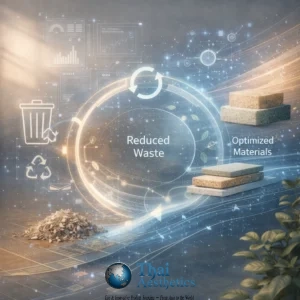

AI STUDIO: INTELLIGENCE AS CREATIVE INFRASTRUCTURE
At Thai Aesthetics, AI Studio is designed as an intelligence infrastructure rather than a creative replacement. Its role is not to dictate design but to reduce uncertainty and improve decision quality across the entire product lifecycle.
AI Studio aggregates inputs from market intelligence, material science databases, sustainability assessments, cost modeling, and sourcing feasibility studies. Designers and decision-makers gain early visibility into trade-offs, risks, and opportunities before physical development begins.
This integration transforms design from a siloed creative function into a cross-disciplinary strategic capability. Product decisions align more closely with business resilience, environmental responsibility, and long-term brand value. Creativity is amplified by clarity.


SUSTAINABILITY BY DESIGN, NOT BY CORRECTION
Traditional sustainability strategies often focus on mitigation after production. Waste reduction, recycling initiatives, and carbon offsets are introduced once products already exist. Predictive intelligence reverses this approach.
By forecasting material availability, regulatory risk, waste generation, and lifecycle emissions early in the design phase, sustainability becomes structural rather than cosmetic. Designers can optimize for durability, recyclability, repairability, or compostability before production begins.
This reduces waste by design, not by apology. Sustainability becomes measurable, repeatable, and scalable rather than symbolic. When intelligence guides sustainability, it becomes a competitive advantage rather than a compliance burden.
DESIGNING SYSTEMS, NOT ISOLATED PRODUCTS
Predictive intelligence reveals patterns beyond individual products. It highlights how products interact, evolve, and age within broader ecosystems. This insight encourages system-based design thinking.
Modular architectures, standardized components, and scalable product families emerge naturally when data shows how consumers adapt products over time. These systems reduce redundancy, simplify sourcing, and improve inventory efficiency while supporting circular business models.
Designing systems rather than isolated objects creates long-term resilience. Products are no longer single transactions but evolving relationships between brands and users.
HUMAN JUDGMENT AND ETHICAL BOUNDARIES
Despite the growing role of artificial intelligence, human judgment remains irreplaceable. Ethics, cultural context, and emotional intelligence cannot be automated.
Predictive intelligence must operate within defined ethical boundaries. At Thai Aesthetics, AI functions as an advisory layer rather than an authority. Designers retain control over interpretation, values, and final decisions.
This balance ensures that technology enhances responsibility rather than undermining trust. Intelligence informs decisions, but humans define purpose.
PREDICTIVE INTELLIGENCE AS A COMPETITIVE ADVANTAGE
Organizations that integrate predictive intelligence into design gain measurable advantages. They reduce time-to-market, minimize costly missteps, align products with future demand, and embed sustainability without compromising profitability.
In a volatile global environment, foresight becomes a strategic asset. Design informed by intelligence is more adaptive, resilient, and aligned with long-term value creation.
Brands that fail to adopt this approach risk producing products optimized for yesterday’s world.
FROM PRODUCTS TO STRATEGY
When predictive intelligence is embedded deeply, it transcends product development. It informs portfolio strategy, sourcing decisions, market expansion, and partnership models.
Design becomes a strategic language spoken across the organization. Finance understands design risk. Operations understand sustainability impact. Leadership gains clarity on where to invest and where to pause.
This alignment transforms design from cost center to value driver.
THE FUTURE OF DATA-LED CREATIVITY
As AI models mature and data ecosystems expand, predictive intelligence will become inseparable from product strategy. Future-ready organizations will treat data not as a reporting tool but as creative infrastructure.
Creativity will not disappear; it will become more disciplined, intentional, and responsible. Designers will spend less time guessing and more time shaping outcomes that endure.
At Thai Aesthetics, this future is already taking shape. Intelligence informs creativity, sustainability is engineered by default, and design becomes an expression of foresight rather than reaction.
PREDICTIVE INTELLIGENCE ACROSS THE PRODUCT LIFECYCLE
Predictive intelligence delivers its greatest value when it is applied not at a single stage, but across the entire product lifecycle. Too often, organizations experiment with AI in isolated functions—marketing analytics, demand forecasting, or supply optimization—without integrating these insights into design decisions. This fragmentation limits impact.
When intelligence spans the full lifecycle, design becomes a continuous, informed process rather than a sequence of disconnected decisions.
During early discovery, predictive models identify unmet needs, emerging behaviors, and long-term usage patterns rather than short-term demand spikes. Designers gain clarity on what problems are worth solving before concepts are drawn.
In the design and development phase, intelligence informs form, material selection, modularity, and durability. Instead of iterating blindly through prototypes, teams can simulate outcomes—cost, waste, compliance, and lifespan—before committing to physical production.
At the sourcing and manufacturing stage, predictive intelligence aligns design intent with real-world feasibility. Material shortages, geopolitical risk, regulatory changes, and supplier capabilities are anticipated rather than reacted to. This prevents late-stage redesigns and production delays.
Finally, in distribution and lifecycle management, intelligence informs packaging optimization, logistics planning, and end-of-life strategies. Products are designed with reuse, refurbishment, or recycling pathways already embedded.
When predictive intelligence flows across the lifecycle, design becomes a system of foresight rather than a series of guesses.
A DECISION FRAMEWORK FOR LEADERS AND BOARDS
For CEOs, board members, and product leaders, predictive intelligence is not a technical tool—it is a decision framework.
At the leadership level, the most important question is not what can AI do? but where does intelligence reduce uncertainty in our highest-risk decisions? These decisions typically involve capital allocation, product portfolio direction, sustainability commitments, and long-term brand positioning.
Predictive intelligence enables leaders to ask better questions:
- Which product categories are structurally aligned with future regulation?
- Which materials will remain viable over the next decade?
- Where will durability outperform novelty as a value proposition?
- Which markets are likely to reward sustainability with pricing power?
By grounding strategy in predictive insight, leadership teams shift from reactive planning to intentional direction-setting. Design becomes a strategic lever rather than a downstream execution task.
This framework also improves governance. Decisions are documented, assumptions are visible, and outcomes can be evaluated against foresight rather than hindsight. Over time, this builds institutional learning and confidence.
RISK REDUCTION AND INNOVATION ACCELERATION
A common misconception is that predictive intelligence makes organizations conservative. In reality, it does the opposite.
By reducing uncertainty, intelligence creates permission to innovate. When leaders understand the risks clearly, they can take bolder positions with confidence.
Predictive design reduces the likelihood of:
- Over-engineered products with no market longevity
- Sustainability claims that fail regulatory scrutiny
- Cost overruns driven by late-stage material changes
- Products optimized for trends that collapse quickly
At the same time, it accelerates innovation by shortening decision cycles. Teams spend less time debating assumptions and more time refining solutions. Creativity is focused, not diluted.
This balance—lower downside risk with higher upside potential—is where predictive intelligence becomes a true competitive weapon.
IMPLICATIONS FOR OEM, PARTNERS, AND ECOSYSTEMS
Predictive intelligence does not only transform brands; it reshapes entire ecosystems.
For OEMs and manufacturing partners, early access to predictive design insight improves planning, investment decisions, and capability development. Suppliers are no longer reacting to sudden demand shifts but co-designing for long-term relevance.
For distributors and retail partners, predictive intelligence enables better assortment planning, reduced inventory risk, and stronger alignment with evolving consumer values.
For sustainability partners, intelligence provides measurable impact rather than aspirational commitments. Lifecycle data replaces marketing language.
In this ecosystem model, design becomes a shared language. Predictive intelligence aligns incentives across stakeholders, reducing friction and increasing trust.
BUILDING LONG-TERM COMPETITIVE MOATS
Perhaps the most underappreciated value of predictive intelligence is defensibility.
Trends can be copied. Materials can be sourced. Aesthetics can be imitated.
But institutional intelligence compounds over time.
Organizations that embed predictive intelligence into design build proprietary insight, decision discipline, and learning loops that competitors cannot replicate quickly. Each product cycle strengthens the system.
This creates a moat not through secrecy, but through capability. Design decisions improve cumulatively. Sustainability performance becomes structurally embedded. Strategic clarity deepens with each iteration.
In a world where differentiation is increasingly fragile, foresight becomes one of the few durable advantages.
FROM REACTION TO FORESIGHT AS CULTURE
Ultimately, predictive intelligence is not a tool—it is a cultural shift.
Organizations that succeed with data-led design move away from urgency-driven cycles toward foresight-driven systems. They reward long-term thinking, cross-functional collaboration, and disciplined creativity.
Designers become strategists. Data teams become enablers. Leadership becomes more deliberate.
At Thai Aesthetics, this philosophy underpins AI Studio: intelligence exists to serve creativity, sustainability, and long-term value—not to replace human judgment, but to elevate it.
CONCLUSION: DESIGNING WHAT COMES NEXT
When data meets design, organizations move beyond reaction and trend dependency. Predictive intelligence empowers brands to design with intention, clarity, and confidence.
The next generation of products will not be guessed into existence. They will be designed through insight, responsibility, and strategic intelligence.
For leaders seeking relevance and resilience, the future belongs to those who design with foresight.